search, compare, detect
Face recognition API, billed per photo.
SightRadar is a face recognition API for three jobs: finding every photo of a person from one selfie (1:N search), checking whether two faces are the same person (1:1 compare), and detecting faces in a photo. You call it over REST or with the Python and Node SDKs, and you pay per photo processed, from $0.00062 a photo.
Updated
What the API does
Faces live in collections, usually one for each event or dataset. You index photos into a collection, then search it.
| Operation | What it does | Endpoint | Price |
|---|---|---|---|
| Index | Detect the faces in a photo and store a faceprint for each one in a collection. | POST /v1/collections/{id}/index | $0.00093 a photo, or $0.00062 in a batch |
| Search | Send a selfie and get back the stored photos that person appears in, with a similarity score for each. | POST /v1/collections/{id}/search | $0.00093 a search |
| Register a selfie | Store one person's selfie under your own user ID, so you can search for them again later. | POST /v1/collections/{id}/selfies | $0.00093 a photo |
| Search by face ID | Search again from a registered selfie, without sending the image again. | POST /v1/collections/{id}/search-by-id | $0.00062 a search |
| Compare | Score two faces against each other and say whether they match at your threshold. | POST /v1/compare | $0.00093 for each image, so two for a compare |
| Detect | Locate every face in a photo and say which ones pass the quality gate. Nothing is stored. | POST /v1/detect | $0.00093 a photo |
Only need to check two faces against each other? The face comparison API page covers the compare call on its own.
Three calls to a first match
Create a collection, index a photo, search with a selfie. The same flow in curl and in the Python SDK.
# 1. Create a collection (free)
curl -X POST "https://api.sightradar.com/v1/collections" \
  -H "Authorization: Bearer $SIGHTRADAR_API_KEY" \
  -H "Content-Type: application/json" \
  -d '{"collection_id": "event-2026"}'

# 2. Index a photo
curl -X POST "https://api.sightradar.com/v1/collections/event-2026/index" \
  -H "Authorization: Bearer $SIGHTRADAR_API_KEY" \
  -H "Content-Type: application/json" \
  -d '{"url": "https://example.com/group-photo.jpg", "photoId": "photo-001"}'

# 3. Search with a selfie
curl -X POST "https://api.sightradar.com/v1/collections/event-2026/search" \
  -H "Authorization: Bearer $SIGHTRADAR_API_KEY" \
  -H "Content-Type: application/json" \
-d '{"url": "https://example.com/selfie.jpg", "limit": 10}'from sightradar import SightRadar
sr = SightRadar() # reads SIGHTRADAR_API_KEY
sr.create_collection("event-2026")
sr.index("event-2026", url="https://example.com/group-photo.jpg", photo_id="photo-001")
result = sr.search("event-2026", url="https://example.com/selfie.jpg", limit=10)Already on AWS Rekognition? The Python shim keeps your boto3 method names. Every endpoint is in the API reference.
Face recognition API pricing
You pay for each photo processed, never for each face. No subscription and no minimum.
| What you pay for | SightRadar | AWS Rekognition | Difference |
|---|---|---|---|
| Batch indexing, per photo | $0.00062 | $0.00100 | 38% lower |
| Real-time call, per photo | $0.00093 | $0.00100 | 7% lower |
| Search by stored face ID | $0.00062 | $0.00100 | 38% lower |
| Storage, per million faces a month | $6 | $10 | 40% lower |
| 1:1 compare of two images | 2 photos | 1 image | AWS is cheaper here |
AWS figures are Rekognition's list price for the first million images a month in us-east-1. With its volume tiers applied, Rekognition's total bill drops below the batch rate above about 37 million images a month, and below the real-time rate above about 1.5 million. See full pricing or price your own volumes with the cost calculator.
Accuracy you can check
These results come from real event galleries: phone selfies searched against professional event photos. The benchmarks page has the method and the known limits.
4.06M
Faces tested
Across 50 real event galleries.
22,070
Real guest selfies
Phone selfies searched against professional event photos.
≤0.13%
False-match rate
Selfies registered by different accounts, compared 1:1 at 0.38 in 5 of the galleries. The 0.42 default is stricter, so it accepts the same pairs or fewer.
96%
Searches that returned photos
Share of 618 guest selfie searches at the 0.42 default that returned at least one photo.
For a different use case, such as access control or ID photos, test on your own images first. The threshold guide shows how to pick an operating point from your own data.
Access and limits
- Sign-up
- Email and an API key. No approval form and no cloud account.
- Rate limit
- 50 requests a second for each key, and 10 requests in flight for each account.
- Batch
- Up to 1,000 photo URLs in one call. Results arrive by signed webhook, so bulk indexing is one request for every 1,000 photos.
- Image formats
- JPEG, PNG, WebP, HEIC/HEIF, TIFF, GIF and BMP, up to 30 MB. iPhone HEIC works without converting.
- Billing
- Prepaid credits with no subscription. A call that fails before processing is not charged.
- SDKs
- Python, Node, a CLI, an MCP server for AI agents, and a Python shim that keeps AWS Rekognition method names.
A dashboard for everything behind the key
- Collections
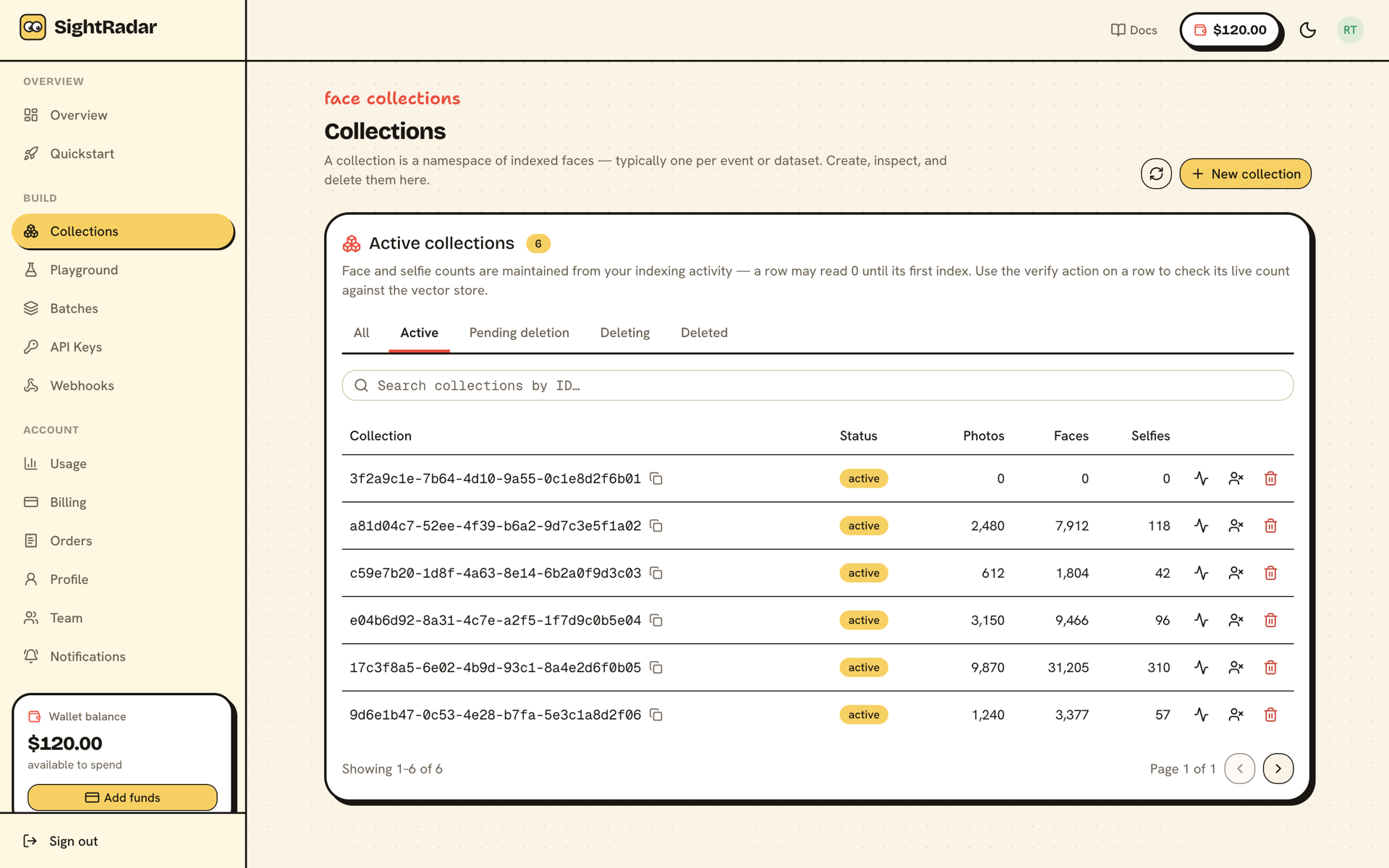
- Photo, face and selfie counts for every collection, with search, status filters and delete.
- Playground
- Run detect, index, search and compare in the browser against your own collection.
- Batches
- Progress for each batch job and a retry for photos that failed.
- Usage
- Spend per operation and per day, with CSV export.
- Billing
- Days of balance left at your recent spend, auto-recharge, and low-balance emails.
When it is not the right fit
- You need labels, text, moderation, celebrity recognition or video analysis. SightRadar does faces only.
- You need liveness detection or ID document checks for KYC. Use an identity verification provider for those.
- You need face tracking on a live camera feed in a mobile app. That calls for an on-device SDK, not a cloud API.
- Face data must stay on your own servers. Look at a self-hosted engine instead.
- Most of your calls are 1:1 compares, or you index more than about 37 million images a month. AWS Rekognition is likely cheaper.
The comparison pages set SightRadar beside AWS Rekognition, Azure Face, Face++, Google Cloud Vision and self-hosted engines. For a wider field, read the best face recognition APIs in 2026, ranked.
Questions about the face recognition API
What is a face recognition API?
It is a web service that takes a photo and returns information about the faces in it. Detection says where the faces are. Recognition goes further and says whose face it is, by comparing it with faces you stored earlier (1:N search) or with one other face (1:1 compare).
How much does the SightRadar face recognition API cost?
You pay per photo processed, not per face: $0.00062 a photo for batch indexing, $0.00093 for a real-time call, $0.00062 for a search by stored face ID, and $6 per million stored faces a month. There is no subscription and no minimum.
How accurate is it?
The benchmarks page publishes the measured results, the method and the known limits. They come from event photography: phone selfies searched against professional event photos. If your use case is different, such as access control or ID photos, test on a sample of your own images before you rely on any published figure.
Is it compatible with AWS Rekognition?
The core Rekognition face operations have an equivalent: collections, IndexFaces, SearchFacesByImage, SearchFaces, CompareFaces and DetectFaces. User vectors and Face Liveness do not. In Python, the official shim keeps the boto3 method names, arguments and response shapes, so you change the import and the constructor. Other languages call the REST API. Stored face vectors do not transfer between engines, so you index your photos again.
Do I pay for every face in a photo?
No. A photo with eight faces costs the same as a photo with one. A photo with no faces is still a processed photo and is charged.
What happens to the photos I send?
The API stores a faceprint, which is a numeric vector, for each indexed face so it can be searched later. You can delete a photo's faceprints or a whole collection through the API or the dashboard. The trust page and the data processing agreement give the details.